Lime Plaster in Modern Architecture: Benefits & Uses

Key Takeaways
- Lime plaster is a natural, breathable, zero-VOC mineral finish made from lime, limestone aggregate, marble dust, and water.
- It actively absorbs carbon dioxide as it cures, recrystallizing back into limestone and lowering a building's carbon footprint.
- Its naturally high alkalinity resists mold, mildew, and bacteria, supporting healthier indoor air.
- Properly applied lime finishes last for centuries and self-heal minor hairline cracks.
- Vasari makes authentic lime plaster, Veneziano (Venetian plaster), Marmorino, Tadelakt, lime paint, lime wash, and mineral primers.
- Lime finishes are easy to repair and maintain, and offer virtually unlimited color and texture options.
What is lime plaster?
Lime plaster is a natural mineral finish for walls, ceilings, and architectural surfaces, made from lime, crushed-limestone aggregate, marble dust, and water.
It is a beautiful, breathable, zero-VOC, and durable alternative to conventional paint, gypsum plaster, and cement-based coatings. Lime coatings can be applied to almost any primeable interior or exterior surface — walls, ceilings, showers, and facades. (Vasari does not recommend its products for floors or countertops.)
Lime has been used in building since ancient times. One of the earliest examples dates to around 7200 BC at 'Ain Ghazal in Jordan, and the Roman architect Vitruvius documented its manufacture in De architectura around 80–70 BC. Today it is returning because it supports healthier interiors, sustainable building, and a refined natural texture that no synthetic coating can replicate.
What is lime plaster made of?
Authentic lime plaster is made from slaked lime, well-graded sand or crushed limestone, marble dust, and water — with hydraulic lime used where tougher or wetter conditions demand it.
- Slaked lime: limestone is fired to produce quicklime, then slaked with water to create lime putty, the binding agent. Modern slaked and hydrated lime are tightly controlled for consistency.
- Sand / crushed limestone: well-graded aggregate gives the mix body, reduces shrinkage, and builds the right thickness.
- Marble dust and limestone powder: improve workability, color depth, and the quality of a smooth finish.
- Water: added gradually until the mix is workable; let a fresh mix activate for about 24 hours, kept covered, before application.
- Hydraulic lime: sets partly through reaction with water and suits exterior or harsher conditions, where it is more water-resistant than air-cured lime.
Producing lime requires far less kiln heat than Portland cement, giving it much lower embodied energy and a smaller carbon footprint from the start.
A brief history of lime plaster in construction
Lime has been a primary building material for more than 9,000 years, used by the Egyptians, Greeks, and Romans, and revived in the modern era for restoration and sustainable design.
The Romans spread lime across their empire — the Colosseum is a lasting example of its strength. Through the medieval and Renaissance periods it remained the standard, until the 19th-century rise of Portland cement pushed it aside. By the late 1800s and early 1900s, lime returned for restoration work, because cement proved too brittle and impermeable to serve well as a thin finish coat. Buildings such as Thomas Jefferson's Monticello and Mission San Juan Capistrano still show its lasting beauty, and architects now pair its history with contemporary design.
| Time Period | Key Development |
|---|---|
| ~7200 BC | Earliest known lime-plaster buildings ('Ain Ghazal, Jordan) |
| ~80–70 BC | Vitruvius documents lime manufacture in De architectura |
| 12th century | Improvements in medieval mortar quality |
| 1756 | John Smeaton identifies clay's role in water-resistant (hydraulic) lime |
| 1796 | James Parker patents natural cement |
What are the environmental benefits of lime plaster?
Lime plaster is low in embodied energy, free of VOCs, and actively absorbs carbon dioxide from the air as it cures — making it one of the most sustainable wall finishes available.
Air-cured (non-hydraulic) lime hardens through carbonation: it draws in CO₂ from the atmosphere and recrystallizes into limestone on the wall. That same process strengthens the finish over time and helps offset the modest emissions from its low-temperature production. Vasari also sources its ingredients in the US, cutting shipping-related emissions.
Lime is highly breathable, allowing moisture to pass through the wall rather than becoming trapped behind it as it does with cement render — which reduces dampness, mold, and long-term maintenance.
| Property | Lime Plaster | Latex Paint / Standard Cement Render |
|---|---|---|
| Breathability | Excellent | Poor |
| Moisture regulation | Natural | Limited |
| Embodied energy | Low | High |
| Service life | Centuries | Decades |
Lime plaster vs. cement, gypsum, and clay
Lime is harder and more durable than clay, far more breathable and repairable than gypsum, and gentler on old masonry than rigid cement.
- Lime vs. clay: both are natural and breathable, but clay is softer and more moisture-sensitive. Lime is harder, more durable, more alkaline, and better suited to interiors, exteriors, and exposed masonry.
- Lime vs. gypsum: gypsum sets fast and is common on drywall, but it performs poorly in wet areas, on old brick, or on exteriors, is hard to repair, and is generally made to be painted over.
- Lime vs. cement: cement is strong but rigid. It can trap moisture, crack, and damage older stone, brick, lime mortar, or lath. It has little reason to be used on interiors.
For traditional and historic buildings, lime is usually best practice because it works with the wall instead of sealing it shut.
How does lime plaster regulate moisture and breathability?
Lime plaster is porous, so it absorbs excess indoor humidity and releases it as the air dries, keeping moisture levels balanced and preventing trapped dampness.
This breathability does several things at once: it improves indoor air quality, reduces the risk of trapped moisture and structural damage, and — thanks to lime's naturally high pH — resists the mold and mildew that thrive on sealed synthetic surfaces. It makes lime an excellent choice for both new construction and the restoration of older buildings, especially in humid climates. The Taos Pueblo in New Mexico has kept occupants comfortable with lime finishes for centuries.
How durable is lime plaster?
Well-made lime plaster lasts for centuries because it continually carbonates into limestone, and it self-heals minor hairline cracks when exposed to moisture.
As it cures, lime takes in carbon dioxide and converts to limestone, producing a surface that grows stronger over time. It can accommodate slight building movement without large cracks — lime-plastered surfaces in Pompeii have survived earthquakes and ground shifts for nearly two thousand years. The result is a finish that needs little upkeep and is easy to patch and blend when it does.
| Characteristic | Lime Plaster | Portland Cement |
|---|---|---|
| History of use | 9,000+ years | ~1900s onward |
| Movement | Accommodates shifts | Prone to cracking |
| Moisture | Breathable | Seals out |
| Historic restoration | Preferred | Generally avoided |
What types of lime finishes are there?
The main authentic lime finishes are traditional sand-lime plaster, Veneziano (Venetian plaster), Marmorino, Tadelakt, and lime paint or lime wash — each with a distinct look and use.
- Traditional sand-lime plaster: a matte or lightly polished plaster for interior walls, ceilings, and exteriors; finish coats are thin but textured.
- Veneziano (Venetian plaster): a polished lime plaster of fine plaster and marble dust, applied in thin layers for a smooth, reflective surface — or left with a mostly matte sheen.
- Marmorino: incorporates fine limestone aggregate for a finish resembling polished limestone, or left matte and unburnished.
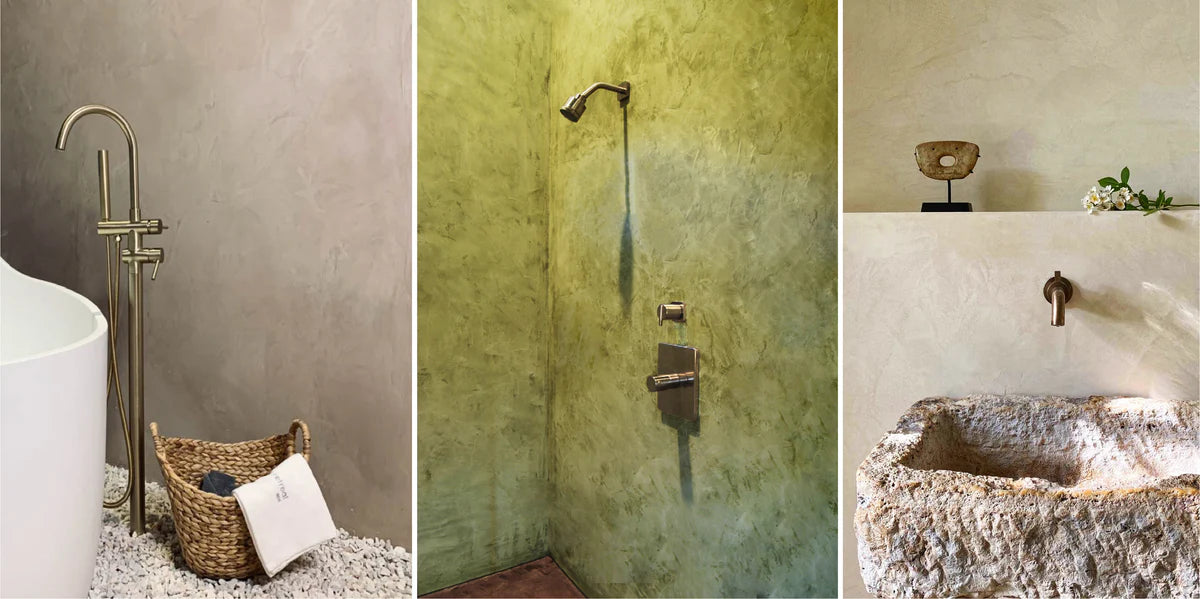
- Tadelakt: a traditional waterproof lime finish for wet areas such as showers and bathrooms.
- Lime paint and lime wash: Vasari Lime Paint has a soft, velvety, opaque texture; thinned with water it becomes a translucent lime wash for a soft, traditional patina.
What are the aesthetic possibilities with lime plaster?
Lime plaster can be tinted to virtually any color and worked into nearly any texture or sheen, from glass-smooth polished walls to heavy sculpted finishes and full fresco murals.
Because lime coatings have a crystalline molecular structure — unlike the amorphous structure of latex paint — they refract and reflect light in a way synthetic finishes cannot. Colors and textures shift with the light throughout the day, giving a space a calming, living quality. Vasari offers 180 standard colors plus thousands of custom matches. Since lime naturally lightens the material, very deep colors can occasionally be a challenge, which is worth planning for during color selection.
"Lime plaster allows buildings to breathe, reducing trapped moisture and stabilizing internal humidity. It's not just about beauty — it's about creating healthy, calming living spaces."
How is lime plaster used in modern architecture?
Architects use lime plaster on both interiors and exteriors as a breathable, carbon-absorbing finish that pairs traditional craft with contemporary, eco-focused design.
Vasari plaster is made with hydrated lime, powdered marble, and crushed-limestone aggregate, forming a breathable finish that lets moisture escape and discourages mold. It integrates naturally with other sustainable methods — straw bale and cob walls, passive solar design, and natural insulation — and it appears in restoration work such as the Michigan State Capitol, where it matched the historic appearance while delivering modern performance. For traditional exterior stucco alternatives, hydraulic limes such as St. Astier are also used in place of color-integrated cement stuccos.
What are the health and comfort benefits?
Lime plaster releases no VOCs, resists mold and bacteria through its high alkalinity, and helps regulate humidity and temperature — all of which support a healthier, more comfortable interior.
- Improves indoor air quality with zero VOCs
- Regulates humidity by absorbing and releasing moisture
- Prevents mold and mildew through naturally high pH
- Adds mineral mass that softens sound and steadies indoor temperatures
How do you prepare surfaces and apply lime plaster?
Prime the surface with a mineral or water-based primer, then apply two to three thin coats, letting each dry before the next and burnishing the final coat for the desired sheen.
Drywall should be hung flat with minimal joint buildup and given a mineral primer for tooth. Masonry and brick should be cleaned of loose paint and dust and pre-wet without standing water. Old plaster should have hollow areas removed and be patched with compatible lime mortar — avoid acrylic or vinyl sealers, which block breathability. Most Vasari techniques have roughly a 15-minute learning curve; the main skill is applying the material in a balanced, organic pattern, and the full video series demonstrates nearly every technique.
When to choose lime plaster — and how Vasari can help
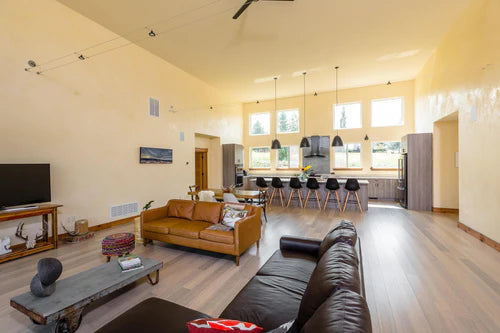
Choose lime plaster when you want a natural, durable, zero-VOC finish with depth, movement, and century-long performance — ideal for high-end homes, hotels, spas, restaurants, historic renovations, sustainable new builds, and DIY projects.
Vasari supplies ready-to-use and dry-mix lime plaster, Veneziano, Marmorino, Tadelakt, lime paint, lime wash, and mineral primers, plus color consultation, sample kits, installer referrals, and training. Contact us for the right product system before you begin, or order a sample set to start.
Frequently asked questions
What is lime plaster made of?
Lime plaster is made from slaked lime, well-graded sand or crushed limestone, marble dust, and water, with hydraulic lime used for wetter or exterior conditions.
Is lime plaster good for the environment?
Yes. It has low embodied energy, contains no VOCs, and absorbs carbon dioxide as it cures, recrystallizing into limestone and reducing a building's carbon footprint.
How does lime plaster regulate moisture?
Lime plaster is porous, so it absorbs excess humidity and releases it as the air dries, keeping moisture balanced and preventing the trapped dampness that leads to mold.
How long does lime plaster last?
Properly applied lime plaster can last for centuries. It continually carbonates into limestone, grows stronger over time, and self-heals minor hairline cracks.
Can lime plaster be used in showers and bathrooms?
Yes. Tadelakt is a traditional waterproof lime finish used specifically for showers and other wet areas. Vasari does not recommend its products for floors or countertops.
What colors and textures are available?
Lime plaster can be tinted to virtually any color — Vasari offers 180 standard colors and thousands of custom matches — and worked into any texture or sheen, from polished to heavily sculpted.
Is lime plaster hard to apply?
No. Most Vasari techniques have about a 15-minute learning curve and involve applying two to three thin coats, then burnishing the final coat for the desired sheen.